

This year, students at the University of Missouri changed their approach to organizing food drives by putting an emphasis on collecting a variety of nutritious food.
The most recent food drive, Tiger Food Fight, was organized by MU's Homecoming Steering Committee. Tiger Food Fight was held on Sept. 18 and collected around 160,000 pounds of food for The Food Bank and the neighbors we serve. Tiger Food Fight is a competition between student organizations to see who can donate the most food. This year, students changed the rules to put an emphasis on "high impact" can donations. In order for a can to qualify as high impact, it must be one of the following:
- Canned fruit like peaches, pineapple or fruit cocktail
- Canned meals including ravioli, chili and soup
- Soups must contain broth and at least one other ingredient
- Canned protein such as chicken, tuna and salmon
- Boxed or bagged rice and pasta


Owen, a student at MU, served on the steering committee and helped organize Tiger Food Fight. He said there were many conversations among committee members and with The Food Bank to figure out how to best serve the community.
"We were so happy to be able to diversify the food so that we're getting proteins and fruits and these things that The Food Bank really needs to be able to properly feed the community and have nutritious meals," Owen said.
Tiger Food Fight wasn't the first student-organized food drive to emphasize variety this year. MU Greek Week held a food drive in March that collected more than 43,000 pounds of food. More than a dozen sorority chapters teamed up with fraternities to donate meals. This year, the students changed the scoring system. In order for organizations to earn points, they had to donate four components of a meal: a fruit, a vegetable, a protein and a starch or grain.
Maddy, an MU student, served as the food drive coordinator for the Greek Week food drive. She said this year was very different from years past, when students would mostly donate green beans.
"We wanted to make a change because we realized that we kind of lost the meaning, and we realized that the food drive and The Food Bank deserves so much more, and we want to be able to provide diversity of food options to people," Maddy said.
The Food Bank staff brought the donated product back to our warehouse. Ultimately, we received a total of 37 pallets of food. Around 40% of the pallets were grains or starches; more than 18% were protein, 16% were fruit, 16% were vegetables and 8% were categorized as miscellaneous.

The Food Bank is grateful to Mizzou Greek Week and the Homecoming Steering Committee for their dedication to donating food that will benefit neighbors across our network!
The Food Bank for Central & Northeast Missouri and its partner agencies gathered in September for their Annual Agency Conference. The conference happens once a year and brings The Food Bank and its 145 partner agencies together as a network to learn from one another.

To kick off the conference, The Food Bank shared accomplishments from Fiscal Year 2026. Together, the network shared 23.3 million pounds of food and other household goods. Of what was shared, 65% was Foods to Encourage, which includes nutritious food like fresh produce, dairy and protein. The network also saved more than 5.2 million pounds of food from the landfill.
The conference included three breakout sessions featuring guest speakers from organizations that support The Food Bank. A member of the Boone County Office of Emergency Management spoke about preparing for a disaster. Mid-MO Harvest Collective and Columbia Center for Urban Agriculture shared about sustaining growth through community gardens. In the third session, a panel discussed the impact of using the choice model.
For the keynote address, Desiree Dillon, the senior director of Neighbor Access and Experience Services with Feeding America, recorded a video.
“I thank you for what you do every day across Central and Northeast Missouri. Thank you for being the people who turn a national mission into local action. Thank you for continuing to learn from your neighbors and from one another,” Desiree said. “And during this Hunger Action Month, I hope you leave today proud of what this network has accomplished and thinking about the next action you can take to make the experience even better for the neighbors who count on all of us.”
This year, the conference offered a “boothapalooza,” where people could walk around to different booths to learn more about a specific topic like nutrition education, volunteer recruitment and more. Two members of The Food Bank Market’s Neighbor Advisory Council hosted a booth to talk with people about the impact of seeking neighbors’ input and ideas to improve the experience at a food pantry.


The Food Bank Director of Community Engagement, Stacey Brown, took time to highlight successes at different partner agencies. Four of the agencies were recognized with a “Friend of The Food Bank” award.
“While we recognize that all of you do the amazing and hard work of sharing food with those who need it, each year there are always a few standouts, and we love to give recognition where recognition is due,” Stacey said. “This is a hard task. With so many awesome partners, it is not easy to single out just a mere few to recognize.”
Stacey presented the awards to VAC Pantry, La Belle First Christian Church Food Pantry, Warsaw Mobile Market and Aging Best. Before presenting each award, Stacey highlighted important work happening at each agency.
This year, VAC Pantry strategically relocated to improve access for unsheltered neighbors and neighbors without means of transportation.
“In their new space, VAC has been able to offer a partial choice model that is customized to individual neighbor resources. Each neighbor can receive a pre-built box of staple food items, and then choose from other available selections, like produce or cooler/freezer items, to complete their visit,” Stacey said. “This hybrid choice model ensures neighbors have access to a full range of nutritious foods, while also ensuring they receive items they can store and use based on their personal resources.”
Volunteers run the LaBelle First Christian Church Food Pantry and are dedicated to getting food into the hands of people who need it.
“As a participant in our Retail Rescue program, LaBelle has built a community around our shared mission of sharing food. Their team of volunteers has worked to create a community value of communication and cooperation so that whenever they get a call from their local Dollar General, big or small, they accept the donations,” Stacey said.
The Warsaw Mobile Market in Benton County received an award for its outstanding dedication to distributing food monthly and for how volunteers navigate long lines at the site.
“There are many neighbors who attend this distribution – a large portion of them coming to the distribution site to secure their place in line even before the sun comes up,” Stacey said. “The mile-long line does nothing to deter this group of dedicated volunteers from showing up every month, rain or shine.”
The fourth and final award went to Aging Best, a congregate meal site that helped The Food Bank guide many of its partnering senior centers through change over the last year. Stacey highlighted Aging Best’s willingness to collaborate and support other partners.
“The ideas and guidance shared by Aging Best with senior centers have been a vital part of our continued partnership with these centers and allow The Food Bank to continue to share food with our senior neighbors right in places where they congregate for food, fellowship and more,” Stacey said.
While these four partner agencies truly accomplished amazing work, The Food Bank is grateful for all of its partner agencies. No two agencies are alike. Some are run by volunteers while others are run by paid staff. Some operate out of a building while others operate out of a Mobile Market. Some are open multiple days a week while others may serve neighbors once a month. Together, they share one important mission: to feed people in need. To all of our partners, thank you so much for everything you do.
Apartment complexes across Columbia, along with their residents, gathered more than 2,400 pounds of food for neighbors in The Food Bank for Central & Northeast Missouri’s service area this summer.
This year marked the second annual Summer Move Out Food Drive, designed to reduce waste and nourish neighbors in our community. The drive happens at a time when many people may be planning to move out of their apartments. This year, nearly two dozen participating complexes placed barrels from The Food Bank in their lobbies so residents could donate unopened food that might otherwise be thrown away.
Marchya, a property manager at Rise on 9th, said participating was a simple process.

“This is one of the easiest volunteer opportunities that we've ever been a part of. Honestly, just by leaving these (barrels) down here, it's something that residents see as soon as they walk in the door. Whether they're going to the grocery store, whether they're moving and they don't want to bring items,” Marchya said. “These (barrels) became filled almost immediately. So it was really easy for us.”
Rylee, a food and fund drive specialist at The Food Bank, drops off empty barrels in May and then regularly stops by the apartment complexes to pick up items throughout the summer. Rylee brings the barrels back to our warehouse, weighs them and then reports the totals back to the apartment complexes.
Residents at Rise on 9th donated 349 pounds of food this summer, outdoing their 2025 total by more than 100 pounds. Rise on 9th says it seeks opportunities to make a difference in its community.
“We're really big on volunteering. Partnering with The Food Bank gave us a really good chance for all of our residents that were moving out to leave the items that they wanted to donate to The Food Bank and help out everybody in the community,” Marchya said.
Altogether, the Summer Move Out Drive collected over 2,400 pounds of food. Feeding America estimates that a meal weighs about 1.2 pounds. This means the drive gathered around 2,000 meals for neighbors facing food insecurity.
After Rylee weighs each barrel, she takes it to the Volunteer Room at The Food Bank. There, volunteers sort through each item to ensure food safety. They check best-by dates and make sure none of the products have been opened or damaged. The donated food can then be distributed throughout our network of partner agencies across 32 counties, helping them share food and bring hope to the 100,000 neighbors we serve each month.
It takes a community to address food insecurity. Whether you host a food drive, donate food, spend two hours in our Volunteer Room, or volunteer at one of our partner food pantries, each role makes a difference.
Thank you to all of the complexes that participated in the 2026 Summer Move Out Food Drive! If you are a property manager and would like to learn how to participate in the 2027 Summer Move Out Food Drive, contact Rylee at RLindsay@sharefoodbringhope.org.
If you’d like to sign up for a shift in our Volunteer Room, check out the list of opportunities on our website.
Hundreds of people gathered at Cosmopolitan Park in Columbia in June for The Food Bank's 9th Annual Hope for Heroes 5K.

Devin Stevenson was one of more than 250 people who ran or walked. This year marked his second time participating in the Hope for Heroes 5K. He stood out in the crowd of runners, carrying an American flag throughout the race. Devin is a member of C.O.L.O.R.S. Guard, which stands for "Carrying Our Loved Ones' Remembered Sacrifices."
"We carry the flag for those who couldn't carry it anymore, whether they were injured in the line of duty or overseas, or fallen, that's why we carry the flags," Devin said.
Devin says he supports organizations that give back to veterans.
"We don't, as a country, take enough care of our veterans. We need to do a better job, and The Food Bank does it, and I'm hoping that organizations can start to see that and support not only The Food Bank but our veterans in general," Devin said.
The Hope for Heroes 5K would not be possible without our sponsors. Columbia Insurance, the presenting sponsor, has been an amazing supporter of The Food Bank for years.
"At Columbia Insurance, we’re committed to supporting communities across our 14-state service region, especially those who have selflessly served in uniform. For nearly a decade, we’ve proudly supported the Hope for Heroes 5K, where it’s always incredible to see neighbors, families and local businesses come together to help fight hunger," Columbia Insurance Communications Strategist Mary Ellen Lohmann said.
Taren Clark and several of her coworkers from Aurora Organic Dairy, another sponsor for the Hope for Heroes 5K, registered to run.
"It was actually my idea. I'm into running, so I convinced all my coworkers to run with me," Taren said. "We support Float Your Boat, and now that that's going away, we did the last voyage this year, we're trying to get into a different thing, and hopefully, the 5k is something we can do every year."

The Hope for Heroes 5K would also not be possible without the support of our volunteers. The Food Bank hosted 18 volunteers this year who served a total of 54 hours. The volunteers helped set up the course, cheered on runners and handed out water and medals.
Including in-kind support (non-cash goods and services), the 9th Annual Hope for Heroes 5K raised more than $65,000 to help support veterans in our 32-county service area facing food insecurity.
The proceeds from the Hope for Heroes 5K will benefit The Food Bank's veterans programs, including the VIP Veteran Pack Program. The Food Bank distributes 560 Veteran Packs a month across 13 counties. Veteran Packs are monthly boxes that include nutritious food and personal care items. These packs include ready-to-eat entrees, soups, fruits, vegetables and toiletries such as razors, body wash and deodorant.
A family who receives Veteran Packs shared with us that getting their box each month brings them joy.
"We are two senior citizens, so it helps us save in millions of ways. It's amazing how much we save on our grocery bill," they said.
The Food Bank plans to grow the Hope for Heroes 5K. The Food Bank President and CEO, Lindsay Lopez, announced at the event that the 10th Annual Hope for Heroes in 2027 will feature both a 5K and a 10K. The race will be held earlier in the year at a new location.
More details about next year's race will be released at a later time.

June is National Fresh Fruit and Vegetable Month, and fresh produce is something worth celebrating!
Fruits and vegetables come in a variety of colors, and each color provides our bodies with different nutrients that support our health. This month, John Coleman, The Food Bank’s nutrition education manager, highlights some potential benefits of “eating the rainbow.”
Check out John's tips for incorporating colorful produce into your meals below!
Red:

- Some red fruits and vegetables get their color from a phytonutrient called lycopene.
- Red fruits and vegetables contain nutrients that may help support heart health and a healthy immune system.
- Some examples include cherries, tomatoes, red bell peppers, strawberries and watermelon.
Orange:

- Orange fruits and vegetables get their color from a phytonutrient called carotenoids.
- Orange fruits and vegetables contain nutrients that may help support healthy eyes and immune function.
- Some examples include carrots, sweet potatoes, oranges, peaches, mangoes and pumpkin.
Yellow:

- Yellow fruits and vegetables get their color from phytonutrients called carotenoids, which are also found in orange fruits and vegetables.
- Yellow fruits and vegetables contain nutrients that may support healthy digestion and support our immune system.
- Some examples include bananas, pineapple, yellow peppers, corn, lemons and yellow squash.
Green:

- Green fruits and vegetables get their color from a phytonutrient called chlorophyll.
- Green fruits and vegetables are packed with vitamins, minerals, fiber and antioxidants that help support overall health.
- Green foods may help support healthy bones, eyes and heart health.
- Some examples include spinach, broccoli, peas, green beans, kiwi, avocados and leafy greens.
Blue/Purple:

- Blue and Purple fruits and vegetables get their color from phytonutrients called anthocyanins.
- These nutrients act as antioxidants and may help support brain health, heart health and healthy aging.
- Some examples include blueberries, blackberries, grapes, eggplant and purple cabbage.
White:

- White fruits and vegetables get their color from a phytonutrient called anthoxanthins.
- White fruits and vegetables contain phytonutrients that may help support heart health, healthy cholesterol levels and our immune system.
- Some examples include cauliflower, onions, garlic, mushrooms, potatoes, parsnips, bananas and pears.
Tips for "eating the rainbow:"

- Try to include at least one serving of fruit or vegetables at each meal or during snacks. Smoothies can be an excellent way to do this!
- Use canned or frozen fruits and vegetables in your home cooking if that makes it easier to have a serving of vegetables at meal times.
- Try swapping out certain foods for a fruit or vegetable. For example, try making a stir fry with riced cauliflower instead of rice.
https://extension.purdue.edu/news/county/elkhart/2022/07/eat-the-rainbow.html
https://www.ndsu.edu/agriculture/extension/publications/what-color-your-food
https://extension.illinois.edu/blogs/healthy-lifestyles-last-blog/2022-01-27-eat-white-fruits-and-vegetables-better-health
https://carolinahungerinitiative.org/eating-the-rainbow/
https://newsnetwork.mayoclinic.org/discussion/eat-the-rainbow-for-good-health/
https://www.health.harvard.edu/blog/phytonutrients-paint-your-plate-with-the-colors-of-the-rainbow-2019042516501
https://health.clevelandclinic.org/phytonutrients
https://pmc.ncbi.nlm.nih.gov/articles/PMC7770496/#sec3

Interfaith Garden tells a story of collaboration, compassion and care. This labor of love was born from a partnership between Congregation Beth Shalom (CBS) and St. Thomas More Newman Center Parish in Columbia.
The garden’s initial roots trace back to 2006, when CBS first established the garden as a servicelearning initiative for students. The concept was to harvest fresh fruits and vegetables and donate the bounty to The Food Bank for Central & Northeast Missouri. Student volunteers served to maintain the garden and enjoy the satisfaction of purposeful work.
By 2009, the garden’s potential had outgrown its initial framework, prompting an invitation to the Newman Center to join the effort. Together, these faith communities expanded the vision, officially transforming the plot into the Interfaith Garden – a testament to the power of collaboration in addressing
complex social and economic challenges.
The Interfaith Garden thrives on the generosity of many hands. Volunteers come from diverse walks of life – scout troops, college students, schoolchildren, church congregants, synagogue members and anyone drawn to the idea of helping others while stewarding the earth.

The garden’s membership in the Community Garden Coalition has been significant, providing essential resources like fencing and raised beds. Grants from Catholic Charities of Central and Northern Missouri have further boosted the garden’s success by funding equipment upgrades and more. These partnerships help reinforce the garden’s identity as a true community endeavor, supported by a collective drive to make a difference for others.
And many hands lead to plentiful harvests. The Interfaith Garden’s very first harvest yielded about 300 pounds of vegetables. Over the years, experience and an increase in volunteers have allowed the garden to achieve an average annual yield of 1,700 pounds.
From tomatoes and peppers to strawberries, sweet potatoes, radishes, okra and more - the wide variety
of crops grown reflects the garden’s coordinators' and volunteers' ambition and care. Garden Coordinator Susan DeMian says that future harvests will see more fruit, too; the garden's orchard is just beginning to
produce persimmons, apples and chestnuts.
The Interfaith Garden also fosters connections beyond its crops. Relationships grow among volunteers, faith groups and the community overall through their shared sense of unity.
In a world often divided by differences, the Interfaith Garden is a reminder of what is possible when we
come together. Here, the act of planting a seed becomes an act of hope and harmony. With every passing year, the garden fulfills its mission to feed the hungry, nurture the earth and bring a community closer together.
If you’re interested in sharing the bounty from your garden with neighbors, learn more about our Garden Giving Program at sharefoodbringhope.org/volunteer/garden-giving.

In the Lake Ozark region amidst vast lake shorelines and rolling hills sits Camden County, a resilient community. Like others across the nations, many residents of Camden County experience - or know someone who is experiencing - food insecurity.
While Camden County is renowned for its natural beauty, drawing thousands of visitors each summer, the struggle for many locals is less visible. The area's rising cost of living has made it even more difficult for some residents to make ends meet. In fact, Camden County, along with neighboring Benton and Morgan Counties, has more food insecure residents than Missouri's average rate of 15%.*
Although food insecurity is keeping pace at a concerning rate in Camden County, it has been a persistent issue for decades. Recognizing this about 14 years ago, local leaders in Camden County joined with The Food Bank for Central and Northeast Missouri to take action against hunger and support their neighbors.
The Camden Mobile Market was originally the brainchild of The Food Bank which piloted the Mobile Market program throughout Central and Northeast Missouri in 2004. The Mobile Market program's purpose is to give food access to neighbors, at no cost, who may live in an area without accessible brick-and-mortar pantries, or areas where the amount of need is higher than local brick-and-mortar pantries can provide.
Turning this from an idea into the solidified program it is today requires more than The Food Bank’s trucks, drivers, and food supply. Mobile Markets require the dedicated partnership of many volunteer members and volunteer groups, whose compassion and commitment to helping those facing hunger would stay steadfast month to month, throughout the changing seasons.
Today, Anita Fleis serves at the heart of this team and has been leading volunteer efforts for this Mobile Market for over a decade. She was brought into this effort, alongside her husband, by the late Bill Fleis, who originally partnered with The Food Bank to pilot the Camden County Mobile Market in Camdenton.

The Camden County Mobile Market initially began operating near Camden County transitional housing on Highway 5, before eventually relocating to its current location at The Church at Osage Hills.
The move was inspired by the challenges Anita and other leaders saw volunteers facing.
“There are a lot of the volunteers who are retired, and carrying big boxes of food to a car was pretty taxing. So… We started chatting with the church in Osage Hills about moving it to their parking lot… and we successfully moved it there,” Anita says.
The Camden County Mobile Market at The Church at Osage Hills is a unique mobile distribution, compared to others hosted by The Food Bank, as they have adopted their own model to efficiently share food with neighbors who visit.
The Church at Osage Hills purchased and stores shopping carts near the parking lot, to then which volunteers are able to fill each cart based on household size, and then bring the cart to a designated vehicle to load food items into the car. This method has served them well, especially during the COVID-19 pandemic.
“This seems to be working efficiently, and we still can have the fellowship, and people could feel served, and we didn't have to worry about who was getting out of their cars and who wasn't…” Anita says of their low-contact distribution model.
This model has also helped them serve households equitably and efficiently while keeping up with high need. On average, the Camden County Mobile Market distribution serves over 400 individuals per month.
“We are called to be the hands and feet of Jesus. I’m honored to serve our community in this way,” says lead volunteer and Church of the Osage Hills Children‘s Pastor, LaDonna Beckmeyer.
At its core, this effort is rooted in a long-standing tradition of compassion from individuals who are deeply committed to supporting those facing hunger in their community. Though the need in this area is great, The Food Bank is able to fulfill its mission thanks to the tireless dedication of volunteers who make this work possible—month after month, year after year, through every season and every challenge.
The Camden County Mobile Market holds particular significance for Anita, who continues this work in honor of her late husband. “It’s very much a passion of mine. It was an even larger passion for my husband, whom I lost to leukemia seven and a half years ago. My hope is that it always continues on,” she shares.
The Food Bank is immensely grateful for the ongoing commitment of remarkable volunteers like Anita and her fellow team members, whose collective efforts make this work possible.
*Feeding America’s 2022 Map the Meal Gap Study

The Food Bank is grateful for members of our incredible community who offer meaningful gifts through monetary donations as well as those who give valuable resources through direct, impactful food donations.
Among these generous supporters are David and Deborah Wehrman, who spent many years on their farm near Centralia, Missouri, tending to their beloved pet cow, Nutmeg. Nutmeg was one of several "Spice Girls," cows within their gentle herd all lovingly named and cared for by the Wehrmans. Each of the Spice Girls helped provide companionship, comfort and a sense of peace to the Wehrman home.
Deborah says that Nutmeg “... lived ‘the life of Nutmeg,’ stress-free and in harmony with others on our farm in rural Audrain County. Her purpose was to keep our pastures trimmed and bring ‘farm life’ to our place.”
As Nutmeg aged, David and Deborah accepted that her life couldn’t be sustained much longer. Having lost several of their other pet cows on their farm in years prior, David wanted to proactively consider ways to use Nutmeg’s passing to make a difference.
“... I don't know that God made cows just to die and bury. So… I thought, well, we ought to get some kind of use out of her. There's a lot of hungry people,” David says.

David heard from others near their farm that Mizzou Meat Market, operated through the College of Agriculture, Food and Natural Resources, was a USDA-certified meat processor. This certification is a requirement for selling and formally distributing meat. After connecting with both Mizzou Meat Market and The Food Bank, the Wehrmans agreed that they wanted to use Nutmeg’s life to help bring grass-fed, antibiotic-free ground beef to those facing hunger in our local communities.
Now, the Wehrmans are able to look back with gratitude on the time they spent with Nutmeg, while also having the assurance that her life has created a legacy of hope by bringing nutritious and valuable protein to those facing hunger. David also states that they plan to make similar donations to The Food Bank in the future.
“Now, [Nutmeg] can serve others,” Deborah says.
Leticia has been volunteering at The Food Bank, in various areas, for over 8 years! She first started volunteering with her church in the Volunteer Room, and then began supporting through other service opportunities.
To Leticia, food means community. "It's how you come together as friends and family… It is a method of relationship and sharing what you have," she says. One of her favorite recipes that she likes to cook at home is Adobo, which can be made with pork or chicken and is seasoned with garlic, black pepper, soy sauce and bay leaf.
Leticia's heartfelt dedication, enthusiasm and compassion is much appreciated by everyone in our Columbia office, and we are incredibly grateful for everything she does for our team and for so many in our local communities!
Homecoming is a tradition that spans back to 1911 and originated here in the Show Me State — at The University of Missouri. Because of this meaningful heritage, each year, the Mizzou Homecoming Steering Committee works to make homecoming engaging and fun. This year, the steering committee also set out to make a real impact in the community, as well. In doing so, the celebration made a big difference for neighbors facing food insecurity.
“We wanted to engage the community beyond the “classic” homecoming events, such as the football game and the parade,” said Steering Committee Director Jonathan Jain.
The group kept The Food Bank’s Volunteer Room busy throughout the entire month of September, as well as hosted Tiger Food Fight with Mizzou Greek Life. Tiger Food Fight is a food drive that has become a Mizzou homecoming tradition, but this year students gathered more than double what was collected compared to past years. In total, the 2023 Tiger Food Fight fundraised $7,492.40 and collected 92,578 pounds of canned food.
The results of the event benefited Tiger Pantry — one of The Food Bank’s partner agencies that serves the Mizzou community — as well as partners across our 32-county service area.
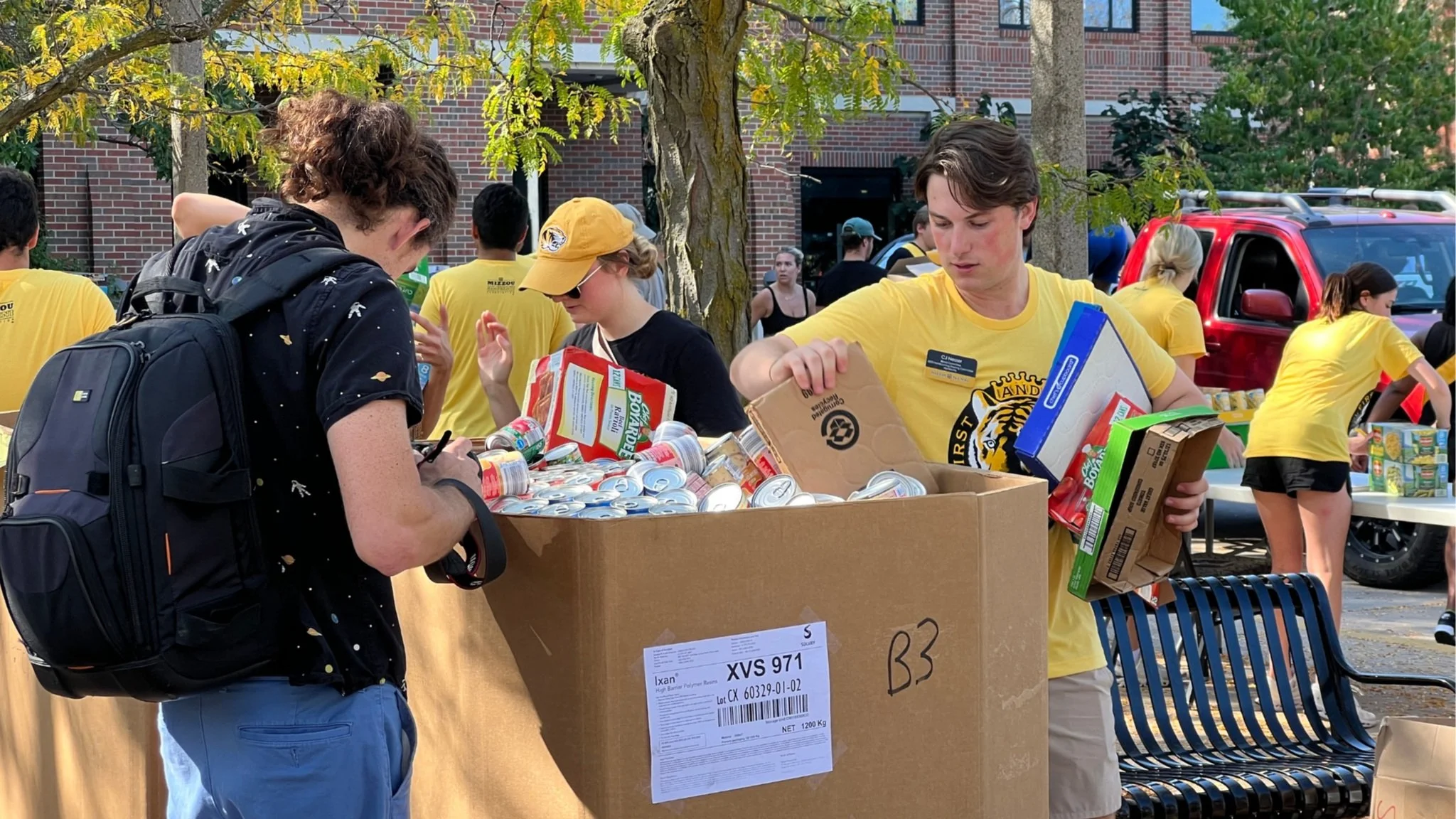
Mizzou Greek Life students unload and sort through donations during Tiger Food Fight, 2023.
Doubling efforts for Tiger Food Fight wasn’t enough for Mizzou Homecoming, though. Instead, they went even further to embody the University of Missouri value of responsibility by organizing another canned food drive and fundraiser for The Food Bank in collaboration with Columbia Public Schools (CPS) and The District.
Columbia schools competed against each other by gathering funds and non-perishable goods. CPS was delighted to collaborate with Mizzou Homecoming to address food insecurity and the challenges it can create for students. According to a Feeding America survey, 46% of children from low-income families report that hunger negatively affects their performance in school.
“It’s difficult to learn when you’re hungry and your basic needs are not being met,” said CPS Spokesperson Michelle Baumstark “This community effort supports our scholars so they can achieve.”
John Ridgeway Elementary School Principal Taryn Brinlee jumped on the opportunity to join in the Mizzou Homecoming drive when she heard about the event. As a smaller school, Brinlee wasn’t sure how the food drive would go for Ridgeway. To help inspire students, she started a friendly competition that encouraged participation. Extra recess time, popcorn and popsicles all sweetened the deal for students. In addition, some parents helped by creating uniquely decorated boxes to boost food collection. The boxes, known as the “food monsters,” were adorned with giant googly eyes, construction paper faces and windows so students could see their progress.
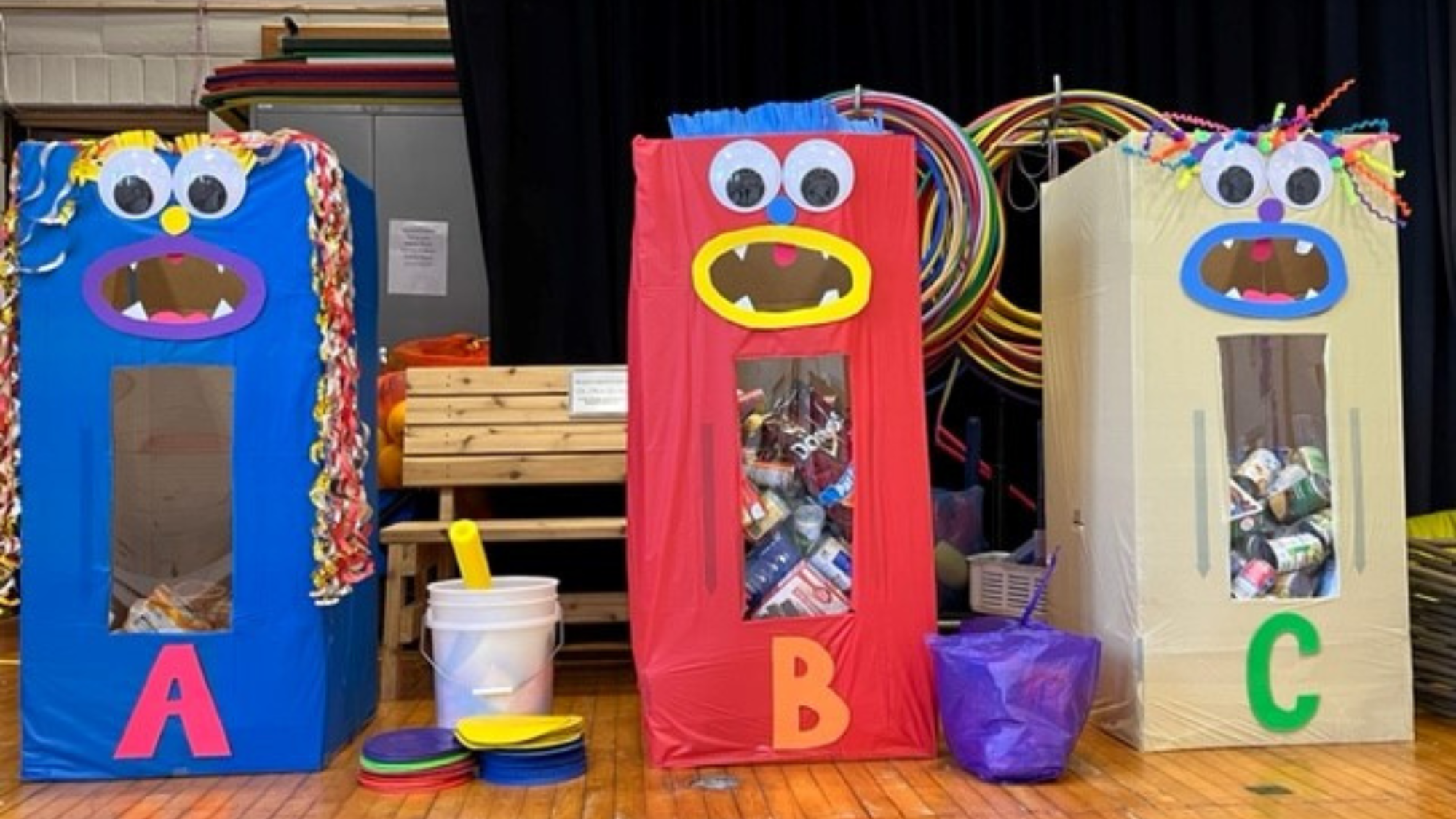
Food donations from students were collected by “food monsters” at Ridgeway Elementary.
In total, CPS gathered 2,496 pounds of food — and despite being one of the smallest schools in the district, Ridgeway Elementary raised almost 30% of that total by gathering an incredible 747 pounds of food.
Brinlee was excited for the win and the collaboration that went into it. “Almost every kid contributed,” she said. “It was truly a group effort.” And Ridgeway Elementary was about to see even more excitement when they received their prize from Mizzou Homecoming.
To celebrate the school that donated the most during the drive, Mizzou coordinated a parade at Ridegeway. The event starred student-athletes, the Mizzou Golden Girls and even Truman the Tiger. Students gathered along the school’s playgrounds to welcome and celebrate the guests. Before the parade even started, Ridgeway students chanted the familiar game day call and response of “M-I-Z” and “Z-O-U.” Armed with pompoms, the children roared as Truman came out and the rest of the parade began.
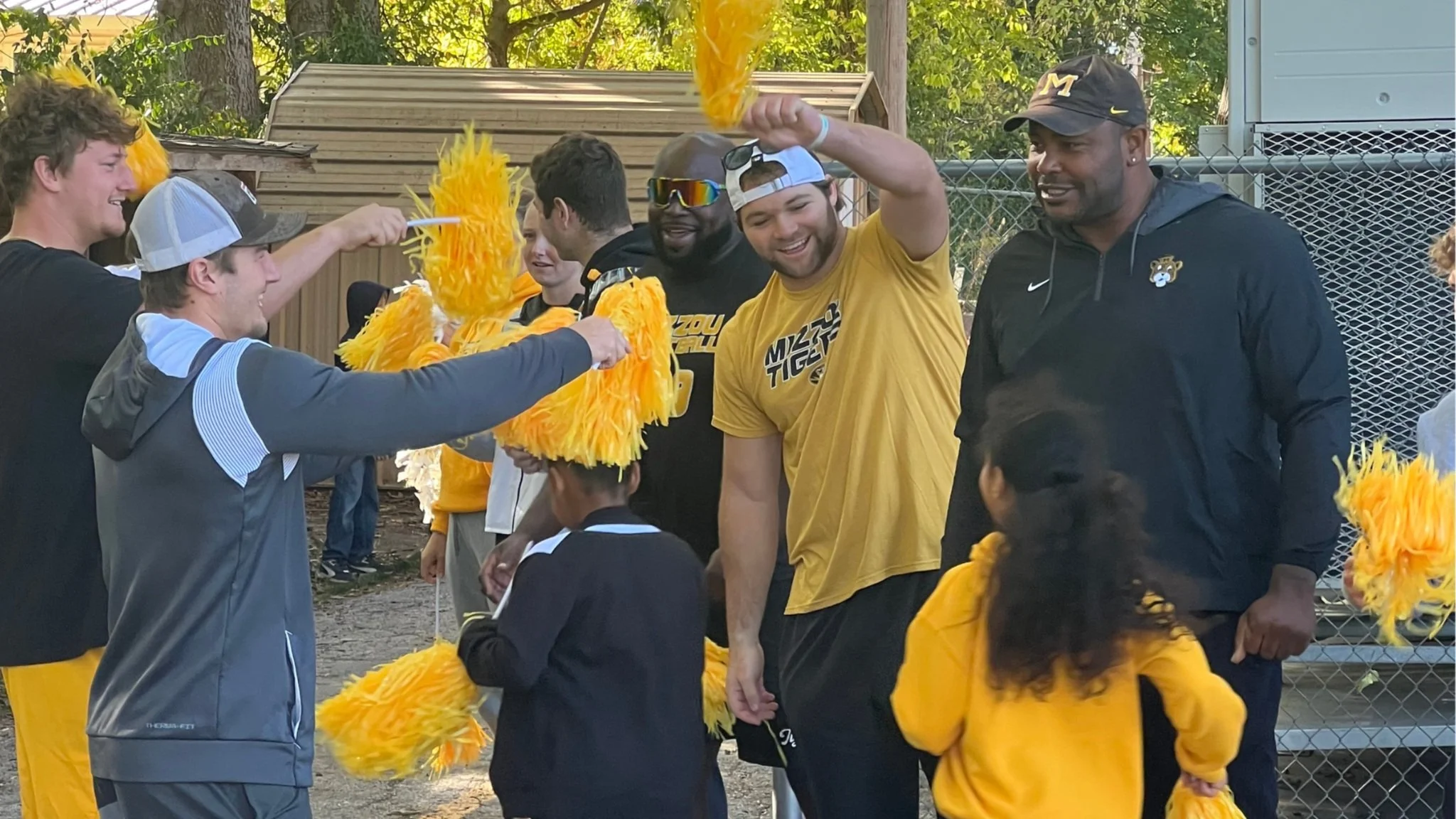
Mizzou athletes and cheerleaders congratulated the crowd of students at Ridgeway Elementary on their accomplishments.
After athletes and cheerleaders congratulated the crowd, the Mizzou visitors gathered in the middle of the playground for a meet-and-greet with students. Class by class, students rushed the group and received hugs, handshakes, high fives and even autographs.
While the children were most excited about the parade, Brinlee hopes the students remember the incredible impact they can have on the community when they work together.
“One little act of kindness has a ripple effect,” Brinlee said. “Even being one person, you can make a difference.”
The experience was certainly memorable for Ridgeway Elementary students, but it was an important lesson for the Mizzou Homecoming team, too. Jain said the students' prize for their collective act of kindness was intended to bring the Mizzou Homecoming Parade experience right to their school.
“We really hope it is a great experience for them and makes them feel special,” he said.
Mizzou Homecoming successfully managed to make a positive impact on students, but on an even larger scale, they also had an impact on thousands of neighbors experiencing food insecurity in our 32-county service area.
“We had great collaboration and partnership with Columbia Public Schools and The Food Bank ... everything really came together,” Jain said.
From a food drive with CPS to Tiger Food Fight to the many hours Mizzou Greek Life served in The Food Bank Volunteer Room, Mizzou students have shown that supporting The Food Bank’s efforts to fight hunger can be wonderfully multi-faceted. One person, one group or one school has the power to make a tangible, lasting difference for those in need.